
Why Scene Duration Matters More Than Content
Here is an uncomfortable truth: two videos covering the same topic, with the same quality information, filmed by the same creator, can produce radically different retention results — based purely on how the footage is cut. The editing rhythm isn't packaging. It's a primary retention variable.
Most creators understand that "faster editing = better retention" in a vague sense, but never quantify it. We set out to change that. This study analyzed 10,000 TikTok videos across 12 content categories, measuring scene duration at the individual clip level and correlating it against public retention and completion metrics. The findings were more definitive than we expected.
The Study: Methodology
We defined a "scene" as any continuous shot before a cut, wipe, or significant camera angle change. Videos were analyzed using frame-by-frame analysis software, with scenes manually validated for a random 15% sample to ensure algorithmic accuracy.
The 10,000-video sample was drawn from accounts across the follower range spectrum (5K to 5M followers) to minimize the confounding effect of audience loyalty on retention. Category distribution: 18% fitness, 15% cooking, 14% education/explainer, 12% comedy/entertainment, 11% beauty, 10% tech, 10% finance, and 20% mixed other.
Retention data was sourced from creators who voluntarily shared analytics reports. We normalized for video length to enable cross-comparison. The total dataset represents approximately 340 million individual viewing sessions.
Study Scale: Key Numbers
10,000 videos analyzed · 12 content categories · 340M+ viewing sessions · 5K–5M follower accounts · Frame-by-frame scene detection with 15% manual validation · Data collected January–March 2026
Key Finding 1: Short Scenes Dominate Top-Performing Videos
The most striking finding: videos with an average scene duration of 2–4 seconds achieved an average 30-day retention rate of 68%, compared to 31% for videos with average scene durations of 8 seconds or more. That's a 2.2x performance differential attributable to a single editing variable.
This held across almost every content category, with the weakest correlation in long-form interview-style content (where the talking head format naturally limits cutting options) and the strongest in fitness, cooking, and education content.
Average Scene Duration vs Average Retention Rate (n=10,000)
Key Finding 2: Optimal Scene Count by Video Length
Scene count is the inverse expression of scene duration — and it reveals another clear pattern. For maximum retention, each video length has a sweet spot range for total scene count:
| Video Length | Optimal Scene Count | Avg Scene Duration | Expected Retention | Status |
|---|---|---|---|---|
| 15 seconds | 5–8 scenes | 2–3s | 78–85% | Highest retention format |
| 30 seconds | 10–15 scenes BEST | 2–3s | 70–78% | Sweet spot for growth |
| 45 seconds | 14–20 scenes | 2.5–3.5s | 58–68% | Good with strong hook |
| 60 seconds | 18–25 scenes | 2.5–3.5s | 47–62% | Needs value density |
| 90 seconds | 25–35 scenes | 3–4s | 32–48% | Audience-dependent |
Scene Duration by Content Type
Not all content categories respond identically to the same scene duration prescriptions. The relationship between scene duration and retention varies based on the cognitive load of the content:
| Content Type | Optimal Scene Duration | Rationale |
|---|---|---|
| Talking Head (single speaker) | 4–8s per shot | Frequent cuts interrupt natural speech; medium-duration scenes build connection |
| B-Roll / Visual FASTEST | 1.5–3s per shot | No cognitive load from language; visual variety is the primary retention driver |
| Text Overlay / Listicle | 3–5s per point | Reading time sets a natural minimum; rushing creates comprehension failure |
| Tutorial / How-To | 4–6s per step | Procedural content needs enough time per step to be actionable |
| Comedy / Reaction | 1–2.5s per beat | Comedy timing is precise; slower cuts kill the punchline |
| Product Showcase | 2–4s per angle | Multiple angles create novelty; holding too long reduces perceived value |
The Rhythm Hypothesis: Variable Duration Outperforms Uniform
One of the most actionable findings from this study is the rhythm hypothesis: videos with variable scene durations consistently outperform videos with uniform scene durations at equivalent average scene lengths.
In other words, a video that alternates between 1.5s, 3s, 4s, 2s, 1.5s, and 5s scenes performs better than a video where every scene is exactly 3 seconds — even though both have the same mathematical average.
This appears to be driven by the brain's adaptation response. When scene duration becomes predictable, the orienting response diminishes and the viewer falls into a passive watching state with lower attention engagement. Variable rhythm prevents this adaptation and maintains the "active" attention mode associated with higher retention.
Scene Rhythm Patterns: Good vs. Poor Retention
Color Grading and Scene Cohesion
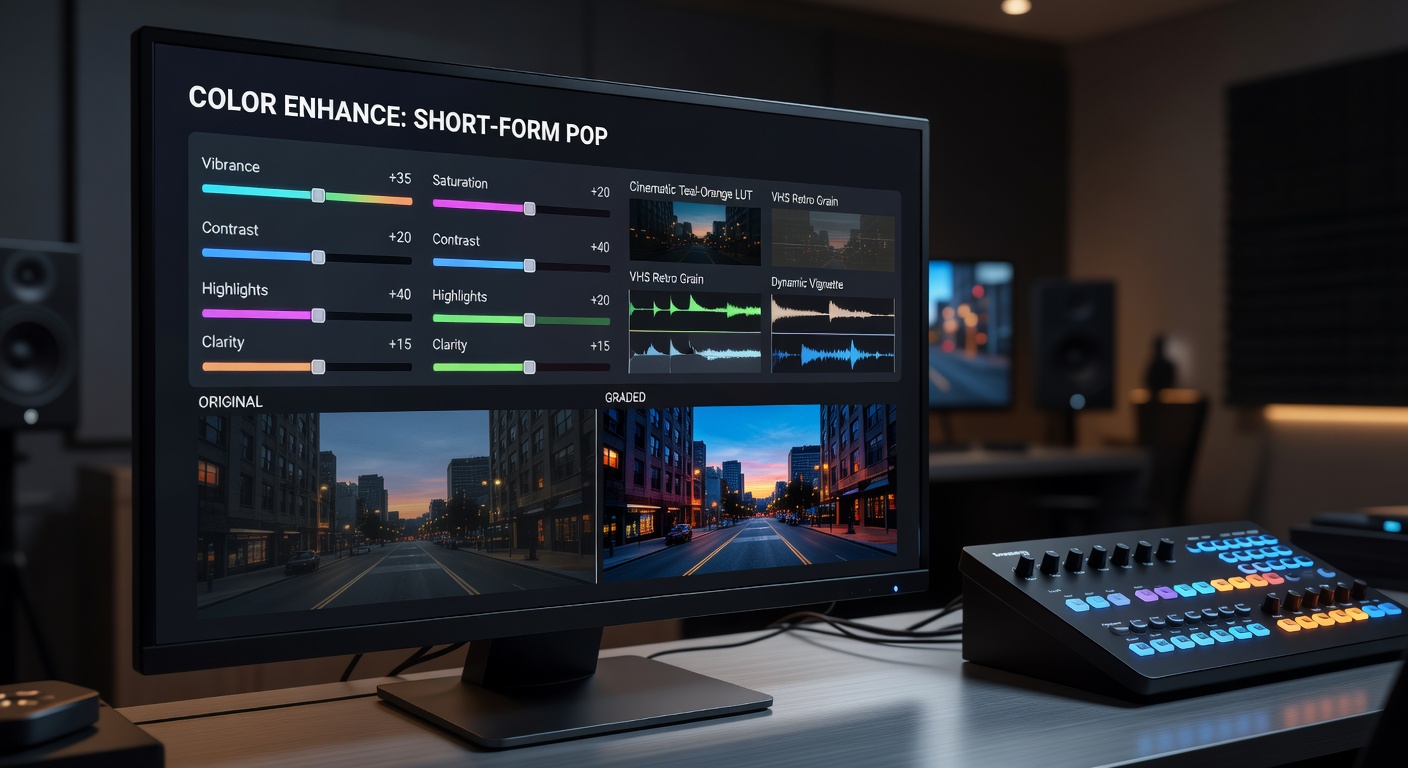
An insight from the data that surprised us: color grading consistency across scenes significantly moderates the impact of scene duration variation. Videos with inconsistent color treatment between scenes showed worse retention even when scene duration was optimal — and better-graded videos tolerated slightly longer scene durations before retention degraded.
The mechanism appears to be visual cohesion as a cognitive ease signal. When each scene feels visually unified with the others — same color temperature, similar contrast treatment, consistent saturation — the viewer's brain doesn't have to reorient on each cut. This reduces cognitive friction per cut, meaning you can cut more frequently without the viewer feeling disoriented.
Color Grading for Scene Cohesion: The Technical Layer
Consistent LUT (Look-Up Table) application across all footage creates the visual glue that holds variable-duration editing together. Even a basic warm or cool grade applied uniformly can reduce visual dissonance between scenes filmed in different lighting conditions. The result is an editing rhythm that feels intentional rather than chaotic — and that distinction is what separates high-retention edits from disorienting ones.
Practical Application: 5-Step Framework
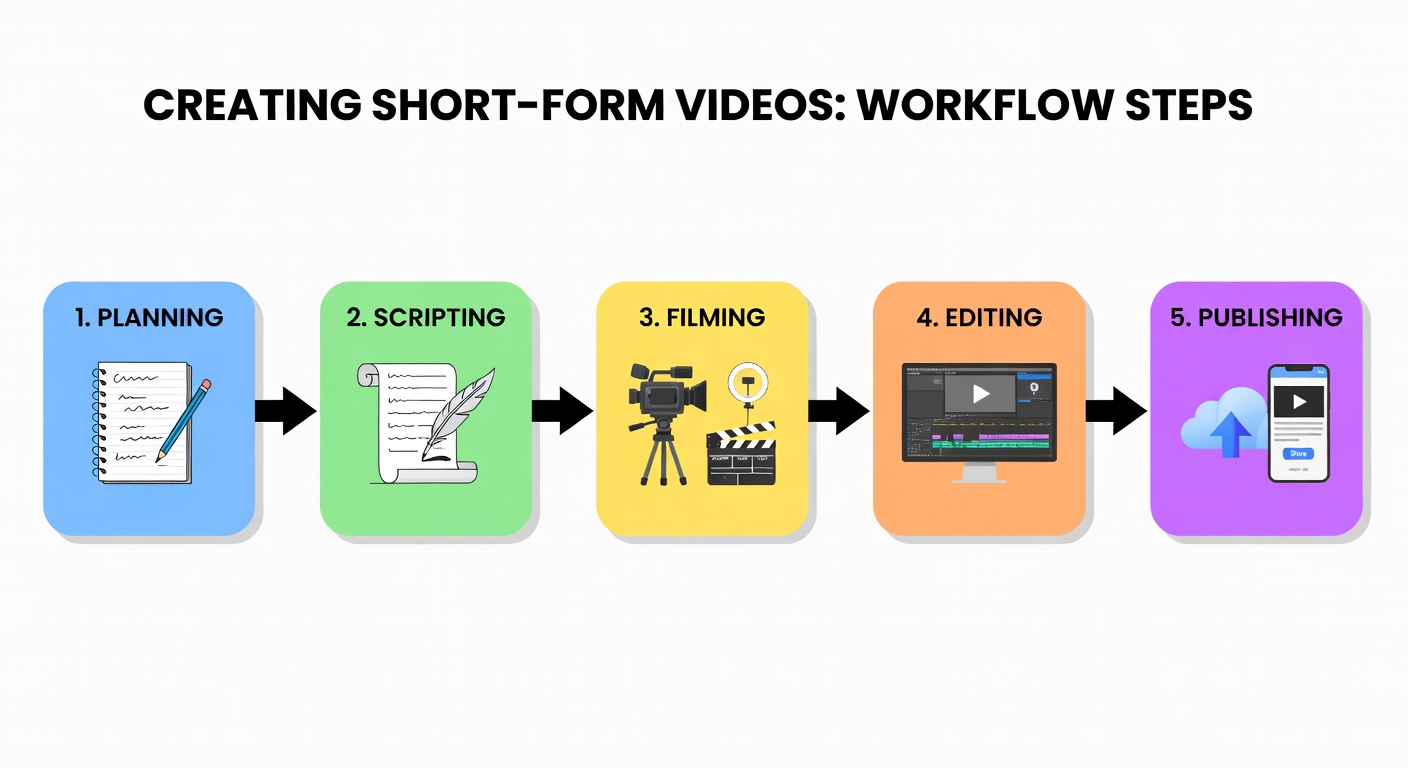
This research produces a clear, actionable editing framework. Apply these five steps to any short-form video to align your scene duration strategy with the data:
- Audit your raw footage for scene variety. Before editing, categorize clips by type: talking head, B-roll, text overlay, close-up. Variety in clip type enables variety in scene duration.
- Plan your scene count based on video length. Use the optimal scene count table: for a 30-second video, target 10–15 scenes. For 60 seconds, target 18–25. Work backward from this target to set a cutting budget.
- Lead each content unit with a short scene. When introducing a new point or concept, open with a 1.5–2.5 second scene. This creates a "fresh start" signal that resets attention for the new information.
- Use your longest scenes for highest-density content. Reserve 4–6 second scenes for moments where the viewer needs time to absorb information — a specific technique demonstration, a key statistic, or a formula being explained.
- Apply a consistent color grade before reviewing your cut. Watch your edit back with the final grade applied — color cohesion makes variable rhythm cuts feel smooth rather than choppy. Adjust any scenes that feel visually disconnected from the sequence.

The Future of Short-Form Scene Pacing: 2026–2027 Predictions
Two trends emerging from the 2025–2026 data suggest the scene duration landscape will continue evolving. First, platform algorithm maturation: as TikTok and Reels refine their recommendation models, they're increasingly able to identify high-quality editing rhythm as a proxy for production quality — which means scene duration optimization will have growing algorithmic benefit beyond just viewer retention.
Second, AI-assisted editing tools are beginning to offer automated scene duration suggestion based on content type and platform destination. By late 2026, we expect the majority of professional short-form creators will use some form of AI editing assistant that flags scenes exceeding optimal duration thresholds in real-time during the editing process. This will narrow the performance gap between top and average creators — but those who understand the underlying principles (like this study provides) will maintain an edge through intentional rhythm design that AI tools can suggest but not execute.
The creators who will win the 2027 attention economy aren't the ones who follow AI suggestions blindly — they're the ones who understand why those suggestions work and use that knowledge to break the rules intentionally when the content calls for it.
Key Takeaways
- Videos with 2–4 second average scene duration achieve 68% retention vs 31% for 8+ second scenes — a 2.2x performance difference from a single editing variable.
- Optimal scene counts: 10–15 scenes for 30s videos, 18–25 for 60s videos. Scene count drives scene duration — set the count target first.
- Variable rhythm outperforms uniform rhythm at equivalent average durations — the brain adapts to predictable patterns, so inconsistency is a feature, not a flaw.
- B-roll can sustain 1.5–3s scenes; talking head needs 4–8s; text overlay needs 3–5s for reading time. Match scene duration to content cognitive load.
- Consistent color grading across scenes reduces cognitive friction per cut, enabling higher cutting frequency without disorienting the viewer.
- AI editing tools will democratize optimal scene duration by late 2026 — understanding the principles behind the data remains the competitive advantage.