
The 1.5-Second Window That Decides Everything
Before a single word of your content is heard, before any value is delivered, before trust is built — a viewer has already decided whether to stay or swipe. That decision happens in 1.5 seconds. Not 5. Not 3. One point five.
Platform data from TikTok, Instagram Reels, and YouTube Shorts consistently confirms this threshold. The scroll stop rate — the percentage of viewers who pause rather than swipe — drops by 60–80% after the 1.5-second mark. If your opening frame doesn't generate a pattern interrupt, the algorithm never gets a chance to show your content to anyone new.
This isn't about gimmicks or shock tactics. The best hooks in 2026 are engineered — structured responses to specific psychological triggers. In this guide, we break down exactly how they work.
The 3 Elements of a Winning Hook
Every high-performing hook shares three structural components. Understanding these elements lets you diagnose why hooks fail and systematically build ones that convert.
1. Visual Disruption
The opening frame must create a visual pattern interrupt — something the viewer's brain registers as "different" from what it was expecting in the feed. This doesn't require dramatic visuals. A close-up face at an unexpected angle, a text overlay in an unusual position, or a rapid motion cut all qualify. The key is contrast with the surrounding feed context.
2. Pattern Break
The brain's default scroll behavior is a habituated motor pattern — swipe, glance, swipe, glance. To stop the scroll, you need to interrupt this cycle with something cognitively unexpected. Audio is often underutilized here: an unusual opening sound, a sudden music start, or silence where music is expected all create pattern breaks.
3. Curiosity Gap
The final element is an open loop — the brain's drive to resolve incomplete information. A question left unanswered, a statement that demands explanation, or a visual that implies a story without revealing it: all create the compelling force that moves the viewer from "stopped" to "watching."
Hook Anatomy: The First 3 Seconds Broken Into Micro-Moments
Hook Formula #1: The Bold Statement Hook
The bold statement hook opens with a declarative claim that is either surprising, counterintuitive, or challenges conventional wisdom in your niche. The formula structure is: "[Most people/creators/businesses] get [X] completely wrong."
This works because the brain's social comparison mechanism is immediately activated. Viewers either agree (validation) or disagree (debate) — both emotional states produce the same result: they keep watching to see if their position is confirmed.
Example: "Most creators spend 40 hours a week making videos that get zero watch time. Here's the thing they're all missing." The phrase "here's the thing" creates a secondary curiosity gap that keeps the viewer through the setup.
Hook Formula #2: The Question Hook
Opening with a direct question to the viewer immediately creates personal relevance. The question must be answerable in the viewer's head within 0.5 seconds — if it requires too much thought, it becomes friction rather than engagement.
High-performing question hooks are specific, not broad. "Have you ever wondered why some creators blow up overnight?" is weaker than "Have you ever posted a video that took 6 hours to make and got 47 views?" The specificity of the second version creates instant recognition for the target audience.
The optimal question hook: personal, specific, slightly embarrassing or relatable, and answerable with "yes" or "no" without thought.
Hook Formula #3: The Visual Hook
Some of the highest-performing hooks on TikTok and Reels use zero verbal communication in the first 1.5 seconds. Instead, they rely entirely on a visually arresting opening frame that creates intrigue through image alone.
Visual hook principles: unusual juxtaposition (unexpected objects together), process in motion (watching something being made), high-contrast color, extreme close-up of something familiar, or visual incongruity (something is clearly "wrong" in the frame).
The visual hook is particularly powerful for muted scrollers — the 60%+ of viewers who watch short-form video without sound in public settings. For these viewers, the visual hook is the only hook. Neglecting it is leaving the majority of your potential audience on the table.
Hook Formula #4: The Controversy Hook
A polarizing opening statement divides the audience into those who agree and those who don't — but both groups watch to validate or challenge the claim. "Hot take: your editing is not the reason your videos fail."
The controversy hook is high-risk, high-reward. It generates strong comment behavior (algorithmic benefit) but can damage brand perception if the controversy isn't resolved with nuanced, credible content. Use it only when you can substantively back up the claim with data or framework — otherwise it reads as clickbait and trains your audience to distrust you.
AI-Assisted Thumbnail Hooks
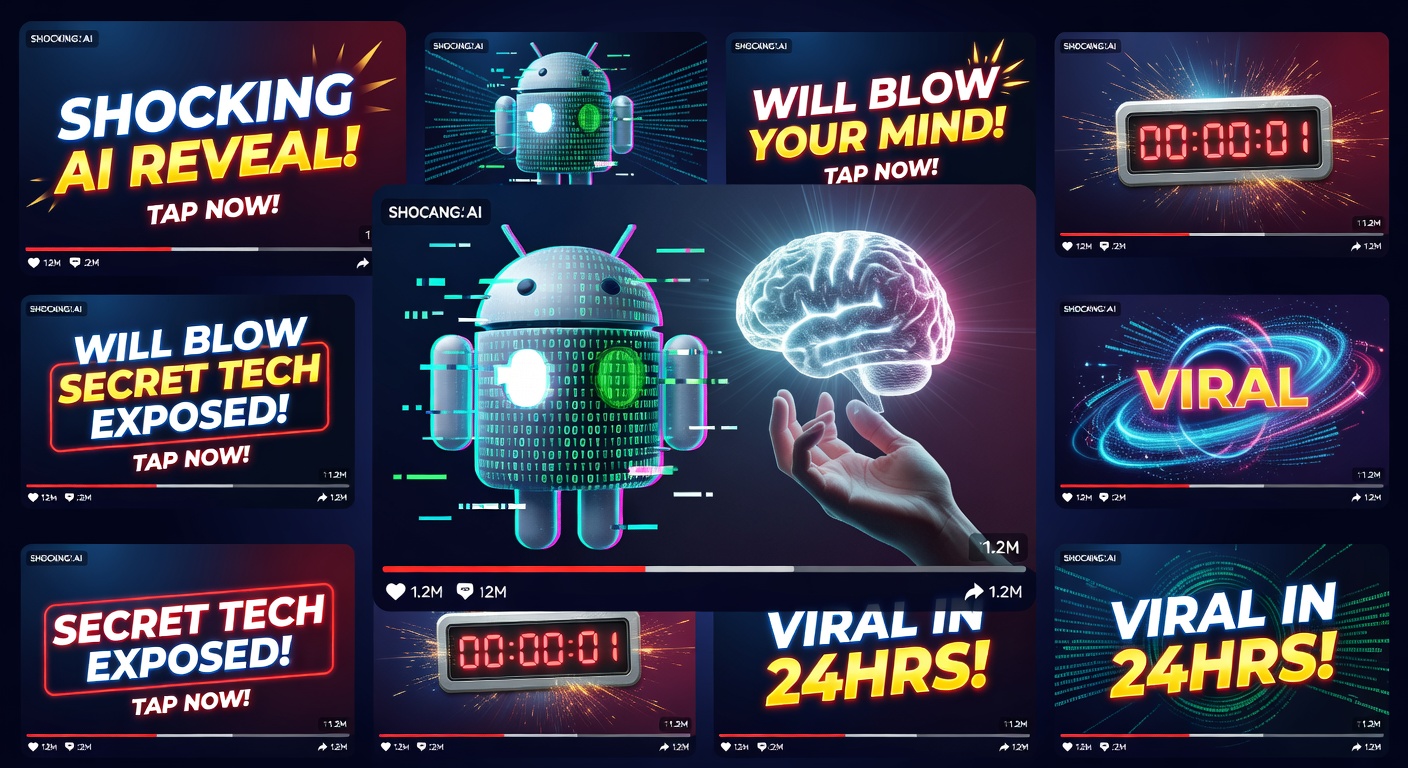
In 2026, AI thumbnail generation tools allow creators to A/B test multiple visual hook options before publishing. Tools trained on platform-specific retention data can score thumbnail candidates by predicted scroll-stop rate. The top performers share three common traits: human face with extreme expression, text overlay under 4 words, and high-contrast color blocking.
Hook Formula #5: The Social Proof Hook
Anchoring your hook with a large, specific number immediately elevates the perceived authority of your content. "10 million people do this every morning without knowing it's damaging their productivity."
The number must be specific and verifiable — or at least plausibly specific. "Many people" has near-zero conversion; "3.7 million creators" creates immediate credibility. The social proof hook pairs naturally with curiosity gap structure: the viewer wants to know whether they're part of the group mentioned.
Testing Your Hooks: The A/B Framework
The only way to systematically improve hook performance is structured testing. The framework is simple: for each video concept, script and record 3 versions of the opening 5 seconds with different hook types. In post-production, cut together each variation as a separate upload.
Metrics to track for hook performance:
- 2-second view rate — percentage of impressions that result in at least 2 seconds of viewing. Baseline comparison metric.
- Average view duration — a strong hook that sets wrong expectations will have high 2-second rate but low AVD.
- Profile visits from video — indicates viewer intent beyond passive watching.
- Saves rate — on Instagram, saves indicate the hook/content matched enough to revisit.
After 5–7 tests per hook formula, you'll have a personal benchmark for which types resonate most with your specific audience — and that data is worth more than any generic best practice.
Platform-Specific Hook Adjustments
TikTok's algorithm serves content to cold audiences first — your hook must work for a viewer who has never seen you before. Reels benefits from a slightly more community-aware hook if you have an existing Instagram following. YouTube Shorts viewers often arrive from your channel page, making authority-based hooks ("After 10 years of studying this...") more effective.
The key platform-specific variable is aspect ratio context. TikTok users scroll vertically in a high-stimulation feed. Instagram Reels viewers are often switching from photo content. YouTube Shorts users may be transitioning from longer-form content. Each context shapes what constitutes a sufficient "pattern interrupt."
Key Takeaways
- The scroll-stop decision happens within 1.5 seconds — every frame before that point is a conversion asset.
- Winning hooks combine Visual Disruption, Pattern Break, and a Curiosity Gap.
- The 5 hook formulas (Bold Statement, Question, Visual, Controversy, Social Proof) map to different psychological triggers — test all five to find your audience's preference.
- Never neglect the visual hook — 60%+ of viewers are watching muted.
- Run structured A/B tests: 3 hook variations per video concept, track 2-second view rate and AVD.
- Platform context matters: cold-audience hooks for TikTok, authority hooks for YouTube Shorts.